-
-
3 Middle Road Hastings Kolkata – 700022, West Bengal, India

Law
Acid Attack laws in India
Acid attack laws in India, under the Bharatiya Nyaya Sanhita (BNS) 2023—formerly IPC Sections 326A and 326B—classify these acts as grave offences, punishing perpetrators with 10 years to life imprisonment for causing injury. Attempting an attack brings 5–7 years of jail, while regulations restrict over-the-counter acid sales and mandate free medical treatment.
Key Legal Provisions (India)
Bharatiya Nyaya Sanhita (BNS) 2023 Section 124 (formerly IPC 326A): Punishes voluntarily causing grievous hurt by acid with a minimum of 10 years imprisonment, extendable to life imprisonment, along with a fine to cover medical expenses. Bharatiya Nyaya Sanhita (BNS) 2023 Section 124(2) (formerly IPC 326B): Punishes the voluntary throwing or attempting to throw acid (even if no injury is caused) with 5 to 7 years imprisonment. Nature of Offence: The crime is cognizable (police can arrest without a warrant), non-bailable, and triable by a Court of Session. Free Medical Care: All hospitals (public or private) are required to provide free immediate treatment and first aid to acid attack survivors.
Regulation of Acid Sale following Supreme Court directives, regulations include:
Logbook Maintenance: Sellers must maintain a register of sales,
including the buyer's address, quantity sold, and purpose.
ID Requirement: A photo ID is mandatory for purchasers, who must be
over 18 years old.
Sale Restrictions: Stocks must be declared to the concerned Sub-
Divisional Magistrate (SDM).
Rehabilitation and Compensation
Compensation Scheme: As per the Bharatiya Nagarik Suraksha Sanhita
(BNSS) 2023, states must provide a victim compensation scheme to
cover medical treatment and rehabilitation.
Victim Support: Victims are often provided with special medical support
and compensation through government initiatives, as highlighted in
cases like Lakshmi v. Union of India
The Crimes identified under the Indian Penal Code (IPC) as Crime against Women are:
- Rape (Sec 375 &376). Download PPT
- Kidnapping and abduction for different purposes (Sec 366, 366A, 366B). Download PPT
- Homicide for dowry, dowry deaths or their attempts (Sec 304B) Download PPT
- Assault or criminal force to woman with intent to outrage her modesty (Sec 354). Download PPT
- Word, gesture or act intended to insult the modesty of a woman (Sec 509). Download PPT
- Cruelty by husbands or his relatives (Sec 498A). Click here to download PPT
The following crimes against women are covered under Special Laws (SLL):
- Immoral Traffic (Prevention) Act, 1956
- Dowry Prohibition Act, 1961
- Indecent Representation of Women (Prohibition) Act, 1986
- Indecent Representation of Women (Prohibition) Act, 1986
- Commission of Sati (Prevention) Act,1987
- National Commission for Women Act, 1990
- Protection of Women from Domestic Violence Act, 2005
- Sexual Harassment of Women at Workplace (Prevention, prohibition and Redressal) Act,2013
Convention on the Elimination of All Forms of Discrimination against Women (CEDAW)
The Convention on the Elimination of All Forms of Discrimination against Women (CEDAW),
adopted in 1979 by the UN General Assembly, is often described as an international bill of
rights for women. Consisting of a preamble and 30 articles, it defines what constitutes
discrimination against women and sets up an agenda for national action to end such
discrimination.
The Convention defines discrimination against women as “…any distinction, exclusion or
restriction made on the basis of sex which has the effect or purpose of impairing or
nullifying the recognition, enjoyment or exercise by women, irrespective of their marital
status, on a basis of equality of men and women, of human rights and fundamental freedoms in
the political, economic, social, cultural, civil or any other field.”
By accepting the Convention, States commit themselves to undertake a series of measures to
end discrimination against women in all forms, including:
- To incorporate the principle of equality of men and women in their legal system, abolish all discriminatory laws and adopt appropriate ones prohibiting discrimination against women
- To establish tribunals and other public institutions to ensure the effective protection of women against discrimination ; and
- To ensure elimination of all acts of discrimination against women by persons, organizations or enterprises.
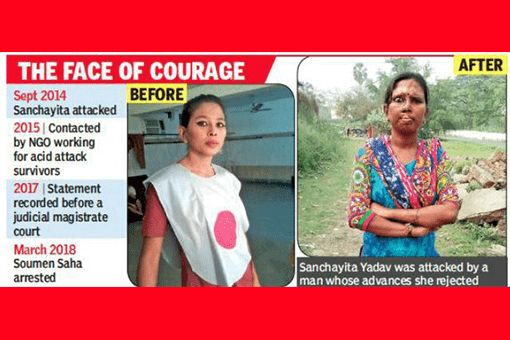
Laws concerning Acid attacks
Indian Penal Code was amended on the 2nd of April 2013 with the passing of ‘The CRIMINAL Law (Amendment) Act. 2013. Click here to download PPT
Legal Support Groups
The National Legal Services Authority (NALSA)
has been constituted to provide free Legal Services to the weaker sections of the society and in every State, State Legal Services Authority has been constituted to give free legal services to the people. Similarly, in every District, District Legal Services Authority has been constituted to implement Legal Services Programmes in the District. The District Legal Services Authority is situated in the District Courts Complex in every District and chaired by the District Judge of the respective district. Section 12 of the Legal Services Authorities Act, 1987 prescribes the criteria for giving legal services to the eligible persons and reads as under:-
- Every person who has to file or defend a case shall be entitled to legal services under this Act if that person is –
- A member of a Scheduled Caste or Scheduled Tribe;
- A survivor of trafficking in human beings or beggar as referred to in Article 23 of the Constitution;
- A woman or a child;
- A mentally ill or otherwise disabled person;
- A person under circumstances of undeserved want such as being a survivor of a mass disaster, ethnic violence, caste atrocity, flood, drought, earthquake or industrial disaster;
- An industrial workman
- in custody, including custody in a protective home within the meaning of clause (g) of section 2 of the Immoral Traffic (Prevention) Act, 1956 (104 of 1956); or in a juvenile home within the meaning of clause (j) of Section 2 of the Juvenile Justice Act, 1986 (53 of 1986) or in a psychiatric hospital or psychiatric nursing home within the meaning of clause (g) of section 2 of the Mental Health Act, 1987 (14 of 1987)
- In receipt of annual income less than rupees nine thousand or such other higher amount as may be prescribed by the 4.5.5 State Govt., if the case is before a court other than the Supreme Court, and less than rupees twelve thousand or such other higher amount as may be prescribed by the Central Govt., if the case is before the Supreme Court.
The Human Rights Law Network (HRLN)
is a collective of lawyers and social activists dedicated to the use of the legal system to advance human rights in India and the sub-continent. HRLN collaborates with human rights groups, and grass-roots development and social movements to enforce the rights of poor marginalized people and to challenge oppression, exploitation and discrimination against any group or individual on the grounds of caste, gender, disability, age, religion, language, ethnic group, sexual orientation, and health, economic or social status. HRLN provides pro bono legal services, conducts public interest litigation, engages in advocacy, conducts legal awareness programmes, investigates violations, publishes ‘know your rights’ materials, and participates in campaigns. [HRLN is a project of the Socio-Legal Information Centre (SLIC). SLIC is a non-profit legal aid and education organization.]

IPROBONO
is a non-profit online network connecting civil society organizations and social businesses in need of legal assistance with lawyers and students who want to use their legal skills for the public good. The network’s global outreach enables people to engage in projects from around the world and allows organizations to source assistance across jurisdictions.iProbono operates globally with field offices in London, New Delhi, Dhaka and Islamabad. iProbono was founded in 2009 as a company limited by guarantee (a non-profit organization) and is registered with the Charity Commission (no.1148556). In India, iProbono is incorporated as a s.25 company.
Legal Aid Services, West Bengal (LASWEB)
one of the pioneering legal aid offering civil society organizations in India, empowers the poor and the disadvantaged with varied legal entitlements. Functioning since 1980 as an organic collective of retired judges, practising lawyers and social activists, we have been providing free legal aid, including litigational support and legal literacy, to a wide range of sufferers. The decision to form a non-political and state-level non-governmental organization to serve the cause of legal aid for the poor and vulnerable sections in West Bengal was taken in a convention of intellectuals held in Kolkata on the 12th of September 1980.In this era of globalized transformations and structural adjustments, LASWEB is striving hard to redress grievances of people experiencing harassment and inconvenience in protracted legal matters.
